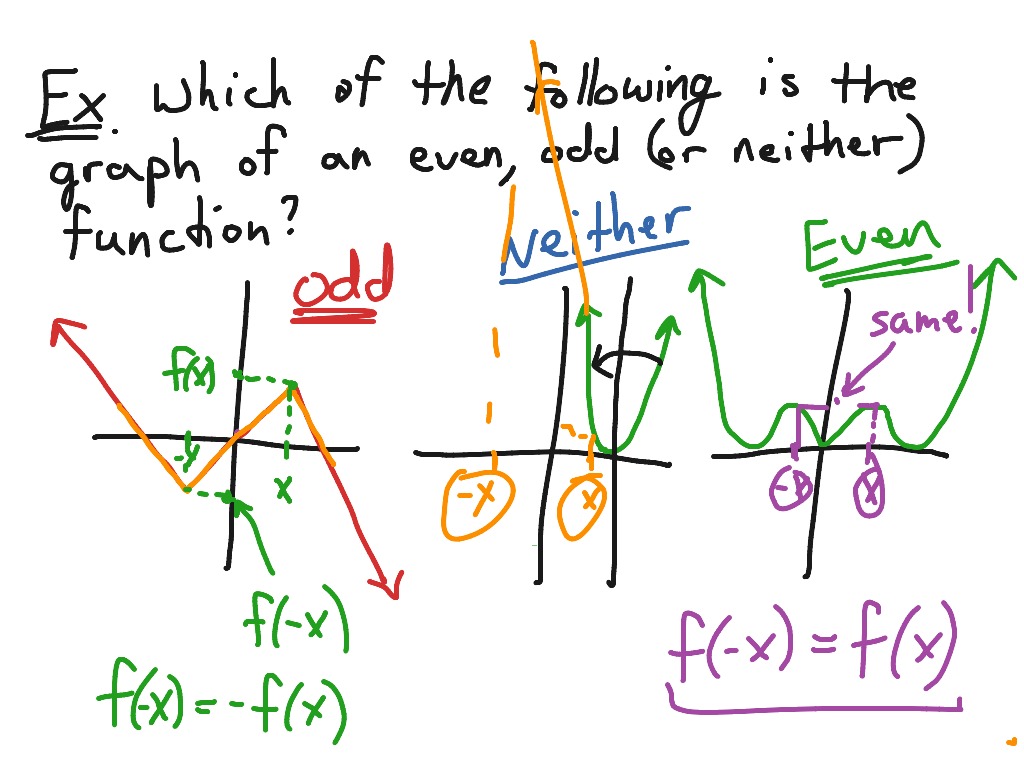
Determine Algebraically Whether The Function Is Even Odd Or Neither
Even Nor Odd
Determine Algebraically Whether The Function Is Even Odd Or Neither Even Nor Odd. It’s easiest to visually see even, odd, or neither when looking at a graph. Don’t be lame and just guess one.
ShowMe even odd neither from www.showme.com
Algebraically, without looking at a graph, we can determine whether the function is even or odd by finding the formula for the reflections. A function is neither odd nor even if neither of the above two equalities are true, i.e.: Let’s try another example of even, odd, neither.
Don’t Be Lame And Just Guess One.
Even and odd functions a function can be classified as even, odd or neither. Let’s try another example of even, odd, neither. This classification can be determined graphically or algebraically.
4.2 Even And Odd Functions Determine Algebraically Whether Each Function Is Even, Odd, Or Neither.
A function is neither odd nor even if neither of the above two equalities are true, that is to say: If we go ahead and compute after the negative x, you get a little bit stuck. Then check your work graphically, where possible, using a graphing calculator.
This Function Is The Sum Of The Previous Two Functions.
Therefore, an online even odd or neither calculator is able to determine whether a function is odd or even. F x x x( ) 1 3 2. So algebraic, that looks like this function meets the criteria to be even.
Algebraically, Without Looking At A Graph, We Can Determine Whether The Function Is Even Or Odd By Finding The Formula For The Reflections.
Determine if odd, even, or neither. Given some “starting” function f\left ( x \right): Determine algebraically whether the given function is even, odd, or neither.
Determine Algebraically Whether The Function Is Even, Odd Or Neither Even Nor Odd.
Little function here, we've got a constant function at quebec's equals eight. We can see that the graph is symmetric to the origin. F as a function of x is equal to 14 times the cube root of x math suppose f (x) is a function which is even but then transformed to an odd function g (x) = af (kx − d) + c.