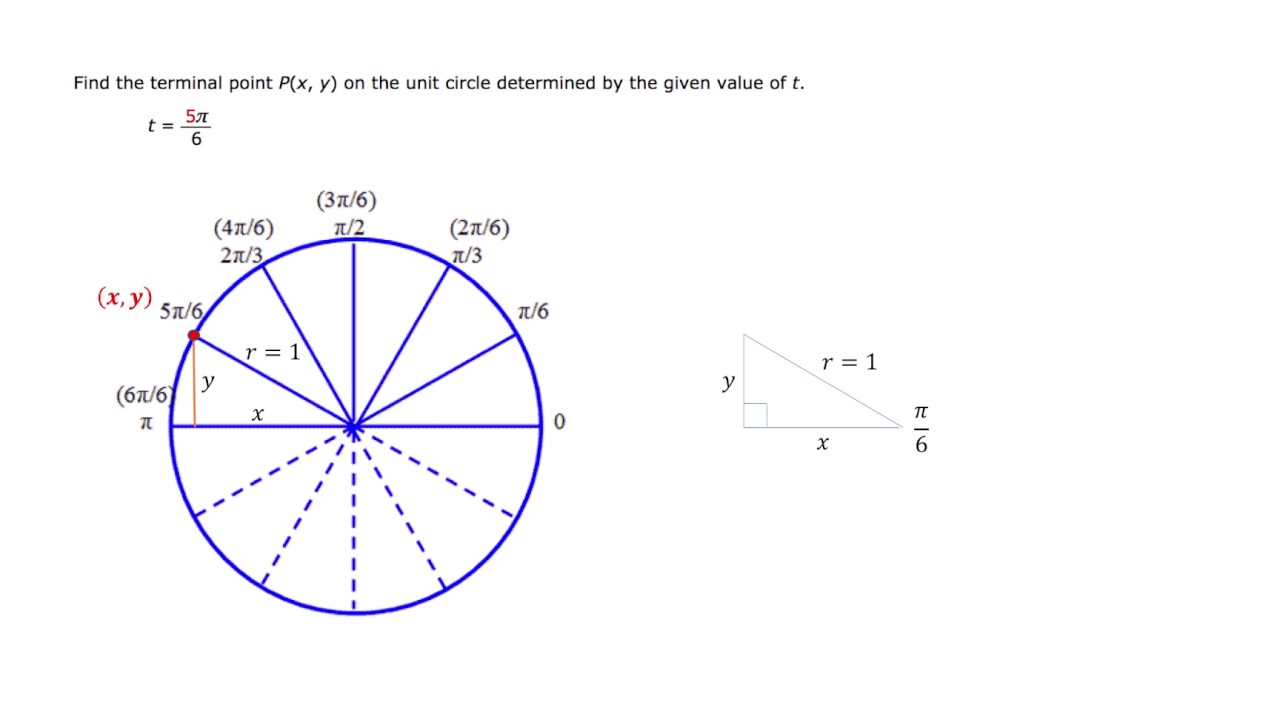
Terminal Point On Unit Circle. Add full rotations of until the angle is greater than or equal to and less than. Let t be a real number.
coordinates of a terminal point on a unit circle YouTube from www.youtube.com
And b is the same thing as sine of theta. The circumference of the unit circle is. Depending on the angle, that point could be in the first, second, third, or fourth quadrant.
We Have Learned About The Different Angles Of Trigonometric Function In.
We go in the counterclockwise direction around the unit circle in order to go through positive angles, starting at θ= 0 over on the positive x. So our sine of theta is equal to b. 6.1 the unit circle using reference numbers to find terminal points for values of ‘t’ outside the range [0,π/2] we can find the terminal points based on the ‘corresponding’ terminal point in the first quadrant.
Different Values Of T Are Represented By The Same Terminal Point.
The point obtained in this way is called the terminal point determined by the real number t. The point you end up at is called the “terminal point” p(x,y). The circumference of the unit circle is.
The Reference Number T’ Associated With T Is
Terminal point on the unit circle. So, if a point starts at and moves counterclockwise all the way around the unit circle and returns to, it travels a distance of 2p. Let θ be an angle in standard position.
Example 4 Using Reference Number To Find Terminal Oint On The Unit Circle
The terminal side will intersect the circle at some point. Another way of looking at terminal points around the unit circle is that the distance t is a real number that is the same as an arc. About press copyright contact us creators advertise developers terms privacy policy & safety how youtube works test new features press copyright contact us creators.
This Means X = Cos T X = Cos T And Y = Sin T.
Since the unit circle is symmetric with respect to the line y = x, it follows that p lies on the line y = x. To find the terminal point on the unit circle, start at (1,0), measure the angle in degree or radian on the circle (move counter clockwise if the angle is positive and clockwise if the angle is negative.) the coordinate of the endpoint is. Then \(\sin t = , \cos t = ,\ \text{and}\ \tan t = \).