Valence Electrons Cobalt. How many valence electrons does cobalt have? 4(b) shows the xps spectra of co2p electron for the cobalt oxide thin films annealed at 500 °c in air.
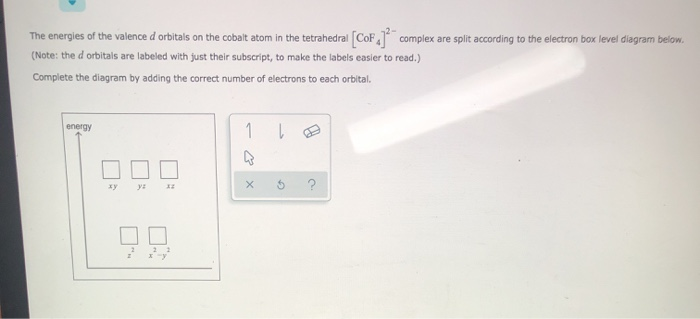
Solved The Energies Of The Valence D Orbitals On The Coba from www.chegg.com
However, if the overall complex has a charge of 3+, then the cobalt also had a charge of 3+. In the periodic table, cobalt has actually nine valence electrons. 4(b) shows the xps spectra of co2p electron for the cobalt oxide thin films annealed at 500 °c in air.
The Lewis Structure Of A Compound Helps Predict Many Of Its Properties.
Ok but how many valence electrons does an atom of cobalt have? Shells hold up to two electrons in the first and eight electrons in the outer shells. Therefore, the valency of cobalt is 1.
The Lewis Structure For Co Has 10 Valence Electrons.
However, if the overall complex has a charge of 3+, then the cobalt also had a charge of 3+. How many valence electrons does cobalt have? Electrons that are found in the outermost shell are generally known as valence electrons and the number of valence electrons determines the valency (or valence) of an atom.
Its Molecular Geometry, Polarity, And Reactivity Can Be Determined By Observing The Corresponding Lewis Structure.
The electron configuration for cobalt at ground state would simply be co: Its final elemental configuration is 3d7 4s2. After a bit of reading, cobalt can have an oxidation state from anywhere from 2+ to 4+, although it technically has 9 valence electrons
While A D Orbital Can Hold Up To 10 Electrons, Less Energy Is Required To Fill The 4S Orbital.
2[co] + 14[cl] = 16 valence electrons. How do you find the total number of valence electrons? Cobalt is a transition metal that does not follow the octet rule.
There Is An Article On This Site Detailing The Electron Configuration Of Beryllium , You Can Read It If You Want.
But the valence electrons of the transition elements are located in the inner orbit. This means two electrons are found in the outermost shell of a single atom of cobalt. The valence electrons determine the properties of the element and participate in the formation of bonds.